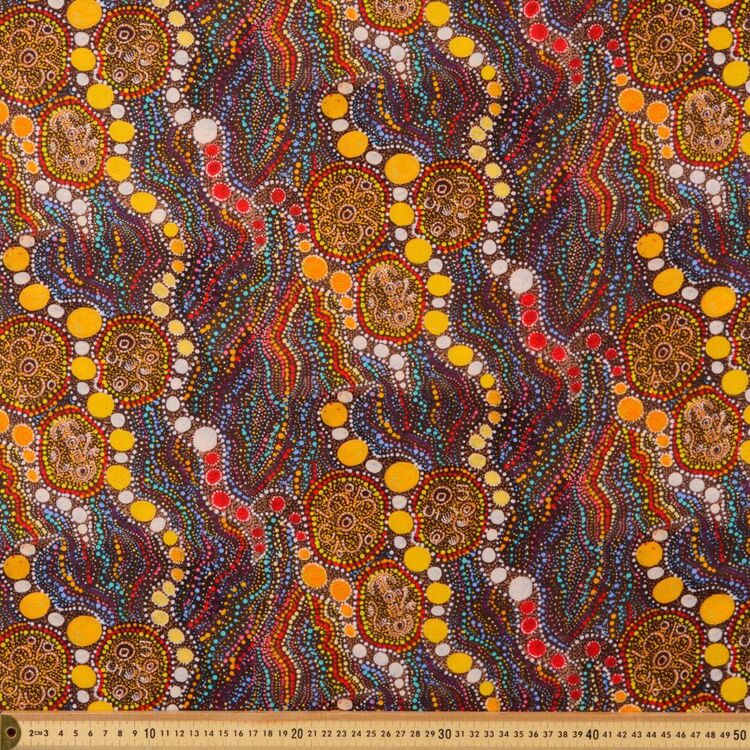
Warlukurlangu Goanna Dreaming #3 112 cm Cotton Fabric
Original price was: $25.00.$10.99Current price is: $10.99.
Celebrate native Australian art with the Warlukurlangu Goanna Dreaming #3 Cotton Fabric! Ideal for quilting and patchwork projects, or making items such as scrunchies, headbands, bookbags, aprons and toiletries bags. Composed of 100% cotton and supplied in a 112 cm width, this material is sold by the metre. Spotlight has a beautiful range of fabrics, manchester and home décor items featuring amazing artwork by the talented indigenous peoples creating with Warlukurlangu, Artists of Yuendumu. Find the perfect piece for your home, in-store or online! Wardapi Jukurrpa by Ruth Nungarrayi Spencer This painting depicts a ‘wardapi Jukurrpa’ (sand monitor/goanna [Varanus gouldii] Dreaming). This dramatic Jukurrpa travels between Purturlu (Mount Theo), approximately 150kms north-northwest of Yuendumu, and Yarripilangu (Newhaven), which is approximately 100kms southwest of Yuendumu. This pain??ng focuses on the portion of the Jukurrpa that takes place at Yarripilangu, which is owned by Napaljarri/Nungarrayi women and Japaljarri/Jungarrayi men. The portion of the Jukurrpa at Purturlu belongs to Napanangka/Napangardi women and Japanangka/Japangardi men. This Jukurrpa tells the story of a Japangardi man named Wamaru who lived at Jarrardajarrayi, an area of country near Purturlu. This Japangardi man lived at Jarrardajarrayi near a soakage called Juntangkalpa. He travelled south to Yarripilangu and approached a group of ‘karnta’ (women) that were siting down in a circle there. He wanted to woo a Nungarrayi woman named Yurlkurinyi who was the wrong skin for him. By tribal law, this woman was his mother-inlaw and their relationship would be taboo. The Japangardi man wooed the Nungarrayi woman and they went up the hill at Yarripilangu where they made love. The earth there turned to ‘ngunjungunju’ (white ochre) and the man turned himself and all the ‘karnta’ (women) into ‘wardapi’ (goannas). The Japangardi man eventually brought the Nungarrayi woman back to Purturlu to live, even though they were the wrong skin for each other. White ochre is still found on top of the hill at Yarripilangu and is used today for love magic and for ceremonial decoration. There’s also a cave where you can see the shape of a goanna entering. There are beau??ful groundwater springs on the east side of the Yarripilangu hill. A number of important Jukurrpa associated with mens’ initiation ceremonies pass through Yarripilangu – these include ‘karnta Jukurrpa’ (womens’ Dreaming), ‘ngalyipi Jukurrpa’ (snakevine [Tinospora smilacina] Dreaming), ‘wati-jarra Jukurrpa’ (two men Dreaming), and ‘wi?? Jukurrpa’ (ceremonial pole Dreaming). In contemporary Warlpiri paintings, traditional iconography can be used to represent the Jukurrpa, particular sites, and other elements. In paintings of this Jukurrpa, the group of women is often represented by concentric circles and ‘U’ shapes. Concentric circles can also illustrate ‘wardapi’ holes and the droppings they leave, while ‘wardapi’ tracks are usually represented by ‘W’ shapes.
| color | |
|---|---|
| Size |
112 cm |